
Increase In ADA Compliance Lawsuits
ADA website compliance lawsuits rose sharply in 2025.


ADA Lawsuits Get Worse.
ADA website compliance lawsuits rose sharply in 2025. 2026 looks worse.
ADA website lawsuits didn’t “trend” in 2025. They stacked up, month after month, in a way that felt mechanical rather than reactive. By December, the pattern was obvious: more cases, filed faster, against smaller companies, with less patience for excuses.
Rough counts from federal PACER data and public settlement disclosures put 2025 at roughly 4,800 to 5,200 ADA website accessibility lawsuits in the U.S. That’s not a clean number because many cases settle quietly or get folded into batch filings, but it’s still a jump of about 18–22 percent over 2024, depending on which district data you trust.
The filings weren’t evenly spread. New York and California accounted for over 70 percent of cases again, with Florida climbing back up after a brief dip in 2023. Illinois stayed steady. Texas picked up pace late in the year.
None of this surprised lawyers who’ve been watching accessibility enforcement since 2018. What changed in 2025 was who got hit and how little warning they got.
What Counts as an ADA Lawsuit
What actually counts as an ADA website lawsuit
Most of these cases rely on Title III of the ADA, which covers places of public accommodation. The statute never mentions websites. Courts filled in the gap.
Some circuits require a “nexus” between a website and a physical location. Others don’t. Plaintiffs’ firms know exactly where those lines are. They file where the law is friendliest and the defendants are least prepared.
Nearly every complaint in 2025 leaned on Web Content Accessibility Guidelines 2.1 Level AA, even though WCAG is not a statute. Courts keep accepting it as the measuring stick anyway.
The alleged failures are repetitive:
- Missing or broken alt text
- Keyboard traps
- Form errors that aren’t announced to screen readers
- Low contrast navigation
- Modal dialogs that hijack focus
No novelty. No edge cases. Just basics that were already well known by 2020.

The plaintiffs didn’t change.
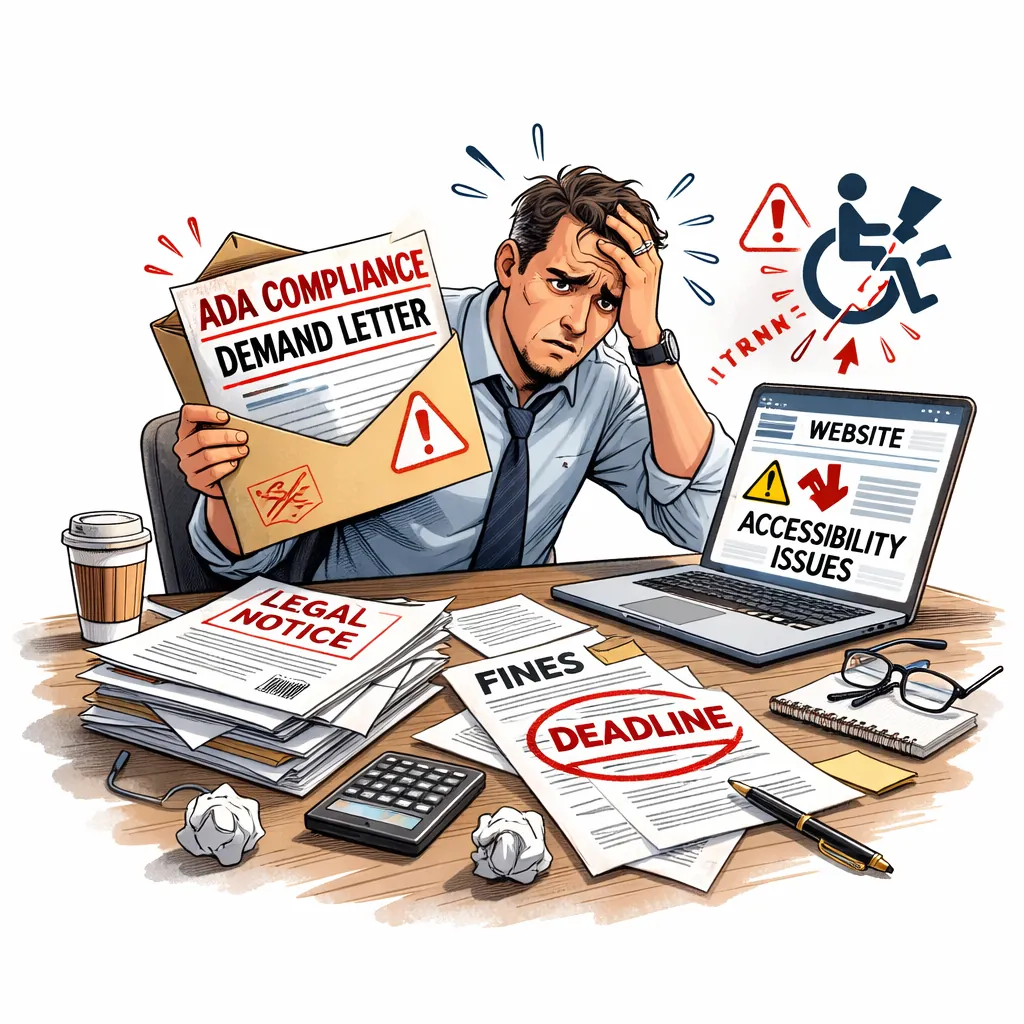
The plaintiffs didn’t change. The targets did.
The same serial plaintiffs appeared again and again in 2025. So did the same firms filing hundreds of nearly identical complaints with swapped business names and URLs.
What changed was the size and sophistication of defendants.
In 2022 and 2023, lawsuits skewed toward national brands, universities, and large retailers. By mid-2025, filings leaned heavily toward:
- Single-location medical practices
- Local restaurants with online ordering
- Small e-commerce shops on Shopify or WooCommerce
- Regional service companies with brochure sites
These businesses didn’t have compliance teams. Many didn’t even have in-house IT. Their websites were built by freelancers, agencies, or DIY platforms.
One example from May 2025: a two-dentist practice in suburban New Jersey was sued over a five-page site built in 2019. The complaint cited 23 WCAG failures. The practice settled for $9,500 plus remediation, which cost another $6,200. Insurance didn’t cover it.
That case never made the news. There were hundreds like it.
Why 2025 accelerated
Why 2025 accelerated instead of cooling off
Several forces lined up at the same time.
DOJ finally stopped hedging
In April 2024, the U.S. Department of Justice issued a final rule clarifying that Title II entities must make their websites and mobile apps accessible. That rule didn’t directly apply to private businesses, but it sent a clear signal: the federal government now treats websites as covered spaces.
Plaintiffs’ lawyers read that as political cover. Courts read it as guidance. Defendants read it too late.

By 2025, accessibility testing had become cheap and automated. Law firms used scripted scans, not manual audits. If a site failed basic checks, it went on a list. A human tester followed just enough to establish standing.
That lowered the cost of filing. When filing costs drop, volume rises. This wasn’t ideological. It was operational.
Settlements stayed cheap enough to encourage more filings
Most 2025 cases settled between $5,000 and $15,000, excluding remediation. That range matters. It’s low enough that defendants rarely fight. It’s high enough that firms can file hundreds of cases and still profit.
Courts didn’t meaningfully punish serial filers. A few judges grumbled. None shut the door.
The WCAG problem nobody likes to admit
WCAG 2.1 AA is the default standard in lawsuits. It’s also vague in practice.
Some criteria are objective. Others aren’t.
Take 1.4.3 Contrast (Minimum). Tools disagree. Human testers disagree. Designers disagree. Plaintiffs still cite it.
Or 2.4.7 Focus Visible. What counts as “visible”? A one-pixel outline? A glow? Courts rarely define it. Defendants settle instead.
This creates a trade-off that rarely gets discussed. Perfect compliance is not realistically provable, but non-compliance is easy to allege.
Businesses end up paying to remediate issues that may or may not have mattered to real users, because the alternative is litigation roulette.
Accessibility overlays didn’t save anyone
By late 2024, dozens of companies had installed JavaScript accessibility overlays. In 2025, plaintiffs sued them anyway.
Complaints explicitly mentioned overlays and argued they didn’t fix underlying code issues. Courts largely agreed. Several settlements required removal of overlays as part of remediation.
One Southern District of New York case in August 2025 referenced an overlay by name and still listed 41 WCAG failures underneath it.
Overlays reduced marketing anxiety. They didn’t reduce legal risk.


E-commerce took the hardest hit
Roughly 38 percent of 2025 filings targeted e-commerce sites, according to a review of docket descriptions in New York and California.
Cart flows are complex. Filters break keyboard navigation. Error messages vanish for screen readers. Payment modals trap focus. Every failure compounds.
Shopify merchants were especially exposed. Many relied on third-party themes and apps that introduced accessibility regressions with updates. When sued, they owned the site anyway.
One apparel store based in Los Angeles settled a case in February 2025 for $12,000. The fix took three weeks and required ripping out a popular product filtering plugin that drove sales. Revenue dipped. The owner told his attorney he’d reinstall it later and “hope nobody notices.”
That’s the other quiet trade-off. Accessibility fixes sometimes clash with conversion tricks. Businesses choose between risk types.
The DOJ’s 2024 Title II rule kicked in enforcement pressure on cities, counties, and public universities throughout 2025. As those entities remediated their sites, their vendors got scrutinized.
CMS providers, ticketing platforms, payment processors, and document hosting tools suddenly had to answer accessibility questions in RFPs. Some couldn’t. Others passed the cost downstream.
Private businesses noticed. Plaintiffs did too. The argument became simpler: if city hall can do it, so can a pizza shop.
Courts still refuse to settle the big questions
Despite thousands of cases, fundamental issues remain unresolved:
- Whether WCAG is legally required or just persuasive
- Whether automated scans alone establish standing
- Whether intent or notice should matter
Defendants keep asking courts to draw lines. Courts keep sidestepping.
That uncertainty favors plaintiffs. It always does.
2026 projections aren’t optimistic
Based on filing rates from Q3 and Q4 of 2025, 2026 is on track for 5,500 to 6,000 ADA website lawsuits, barring a major appellate decision or legislative action. Neither looks imminent.
New York alone averaged over 100 filings per month by November 2025. California hovered around 60. Florida crept back toward 40.
Even a modest increase in automated scanning or plaintiff capacity pushes totals higher.
What businesses still get wrong about risk
Many owners think size protects them. It doesn’t.
Many think plugins solve it. They don’t.
Many think nobody with a disability uses their site. Plaintiffs don’t need to prove heavy use. Just attempted use.
Many think fixing issues after a demand letter helps. Often it doesn’t. Standing is established at the time of filing.
The only reliable risk reducer in 2025 was ongoing, code-level compliance, documented and maintained. Not one-time audits. Not badges. Not promises.
A concrete example that shows how small the margin is
In July 2025, a Midwest HVAC company with no online sales was sued. The claim centered on an online contact form. The submit button wasn’t reachable by keyboard. That was it.
The site had passed a basic automated scan months earlier. The form came from a third-party CRM embed added later.
Settlement: $7,500. Fix time: two hours. Legal fees dwarfed both.
That case explains the trend better than any graph.
The criticism that keeps coming up — and keeps failing
Defense attorneys argue these lawsuits don’t improve accessibility. They say serial filings help lawyers, not users.
There’s truth there. Many settlements don’t include monitoring. Some fixes regress later. Plaintiffs rarely revisit sites.
Courts still allow the cases. Congress still hasn’t acted. Businesses still pay.
Complaining about the system hasn’t changed the outcome yet.
Why AI search and discovery are amplifying the issue
Search engines and AI assistants now surface accessibility signals indirectly. Structured content, semantic HTML, and clear navigation help both accessibility and machine interpretation.
That overlap means accessibility failures increasingly look like quality failures. Sites that break screen readers also confuse crawlers and summarizers.
Businesses trying to rank in 2026 without addressing accessibility will feel pressure from both sides.
Where this leaves 2026
ADA website lawsuits aren’t peaking. They’re standardizing.
The playbook is stable. The incentives work. The law remains vague. The volume rises.
For businesses, the decision isn’t philosophical. It’s arithmetic. Fixing issues costs less than settling, but only if it’s done before the complaint is filed.
Most companies still wait. The filings keep coming.